
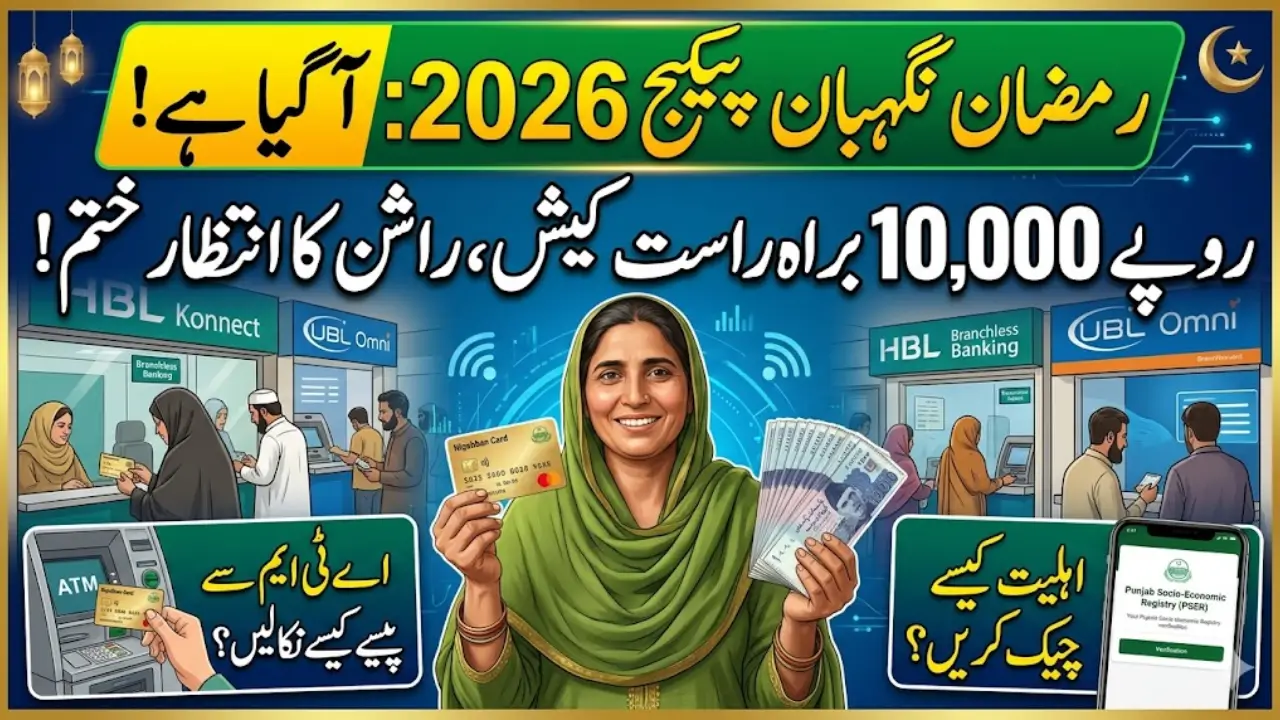
The Ramzan Nigehban Package 2026 is a welfare initiative introduced by the Government of Punjab to provide financial relief to low-income families during the holy month of Ramadan. Rising food prices and daily expenses make Ramadan difficult for many households, so the government designed this program to ensure that deserving families can manage essential purchases without financial stress.
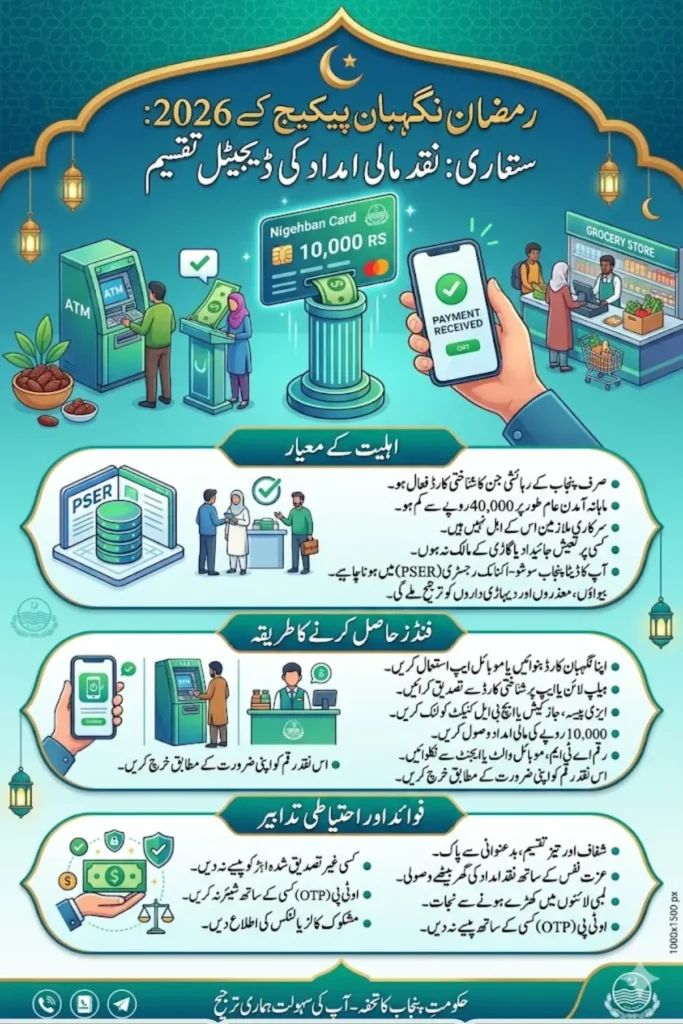
A major feature of this program is the Nigehban Card, a digital financial assistance system that replaces traditional ration distribution methods. Instead of waiting in long lines for food packages, eligible families receive Rs 10,000 in financial assistance that can be used according to their needs.
The program focuses on transparency, dignity, and faster distribution through digital systems. Beneficiaries can receive payments through mobile wallets or use the Nigehban Card to withdraw cash and purchase groceries from registered stores.
Key goals of the Nigehban initiative include:
- Supporting low-income families during Ramadan
- Providing direct financial assistance of Rs 10,000
- Reducing corruption through digital verification
- Allowing families flexibility in grocery spending
- Ensuring quick and transparent distribution
What is the Nigehban Card and How It Works
The Nigehban Card is a new digital support system introduced in 2026 to simplify the distribution of Ramadan financial assistance. It functions similarly to a debit card and allows eligible beneficiaries to access funds easily without visiting government offices repeatedly.
You can also read: Prime Minister Ramzan Package 2026
Through this card, registered families can withdraw their financial assistance from ATMs or purchase subsidized groceries from approved retailers. The system is connected to the Punjab Socio-Economic Registry (PSER), which verifies eligibility using household data and CNIC information.
This digital approach helps ensure that assistance reaches the correct families while minimizing delays and administrative errors.
Important features of the Nigehban Card include:
- Withdrawal of Rs 10,000 assistance from ATMs
- Payment for groceries at registered stores
- Use through branchless banking agents
- Digital verification using CNIC
- Reduced waiting time at distribution centers
- Secure and transparent financial transfers
The card also helps families maintain dignity by avoiding the public distribution lines that were common in older relief systems.
Eligibility Criteria for the Nigehban Card Distribution
The Nigehban Card is designed for households that are facing financial difficulties and require support during Ramadan. Eligibility is determined through government data records, mainly from the Punjab Socio-Economic Registry (PSER).
Authorities review household income, assets, employment status, and other socio-economic indicators to determine whether a family qualifies for assistance.
Below is a general overview of the eligibility requirements.
| Requirement | Details |
|---|---|
| Residency | Must live in Punjab |
| CNIC | Valid and active CNIC required |
| Monthly Income | Usually below Rs 40,000 |
| Employment | Government employees generally not eligible |
| Assets | No luxury property or expensive vehicles |
| Database Verification | Must be listed in PSER database |
Certain groups are given priority because they are considered more vulnerable.
Priority groups often include:
- Widows and female-headed households
- Daily wage laborers
- Disabled individuals
- Families with very low income
- Households already registered in social welfare databases
Meeting these criteria does not automatically guarantee approval, but it increases the chances of receiving assistance.
How the Nigehban Card Distribution System Works
The distribution process for the Nigehban Card is designed to be simple and efficient. Instead of relying on manual verification or physical ration distribution, the system uses digital tools and SMS communication.
Once a family is verified through the PSER database, they receive an official notification about their eligibility. After verification, the financial assistance is transferred through digital channels linked with the beneficiary’s CNIC.
The distribution system mainly works through the following channels:
- Mobile wallets such as Easypaisa or JazzCash
- Nigehban Card ATM withdrawals
- Branchless banking agents including HBL Konnect and UBL Omni
- Official helpline services for verification
This digital system reduces corruption and helps the government deliver support faster to rural and urban communities. Another advantage of digital distribution is that beneficiaries can use the funds according to their own needs. Families may purchase groceries, pay utility bills, or manage other essential household expenses during Ramadan.
You can also read: CM Punjab Lanuch Yateem Card 2026
Step-by-Step Guide to Receive Nigehban Payment
Eligible families can receive their financial assistance by following a simple verification process. The government has introduced multiple methods to make the system accessible to everyone.
One common method is through the official mobile application developed by the Punjab government. This app allows beneficiaries to check their application status and link their mobile wallets for direct payments.
Basic steps to receive the payment include:
- Download and open the official application
- Log in using your CNIC number and registered mobile number
- Check your eligibility status
- Link your mobile wallet account
- Wait for the confirmation SMS
- Receive the Rs 10,000 transfer
For individuals who cannot use smartphone applications, an alternative method is available through the helpline service. Nighaban Card Distribution Launch
Helpline verification process:
- Call the official helpline from your registered mobile number
- Provide your CNIC for identity verification
- Confirm your mobile wallet details
- Wait for the payment confirmation message
Both options are free of cost and do not require any agent or middleman.
Common Problems in Nigehban Card Distribution
Although the digital system is designed to simplify the process, some beneficiaries may still face issues during registration, verification, or payment transfer. These problems usually occur due to incorrect personal information or technical delays. One of the most common issues is payment not received even after approval. In many cases, this happens when the mobile wallet is not properly linked to the beneficiary’s CNIC.
Other problems may arise due to outdated information in official databases or errors in SIM registration.
Common problems reported by applicants include:
- Payment not received after eligibility confirmation
- Application status showing “under review” for a long time
- CNIC verification failure
- Incorrect or inactive mobile number
- Mobile wallet not linked with CNIC
- Delay in SMS notifications
These problems can usually be resolved by updating personal records and contacting official support services. Nighaban Card Distribution Launch
Solutions to Nigehban Card Distribution Issues
Most technical or verification issues can be solved easily if beneficiaries follow the correct steps. Government departments recommend checking personal information first before submitting complaints.
If the payment has not been received, beneficiaries should confirm whether their mobile wallet is properly registered with their CNIC. Linking the correct account often resolves the problem.
Solutions to common issues include:
- Verify that your CNIC is active and valid
- Ensure your SIM card is registered in your own name
- Link your Easypaisa or JazzCash wallet with CNIC
- Avoid submitting multiple applications
- Wait for the official confirmation SMS
- Contact the helpline for assistance
In cases where CNIC information is outdated, visiting the nearest NADRA office may be necessary to update personal details. Keeping records updated helps avoid delays and ensures faster payment processing. Nighaban Card Distribution Launch
Safety Guidelines for Beneficiaries
During large welfare programs, fraudulent activities sometimes appear in the form of fake agents or unofficial messages. Beneficiaries must remain careful and follow official procedures only.
The government has clearly stated that all services under the Nigehban Package are completely free. No agent or organization is authorized to charge fees for registration or payment processing.
To stay safe, beneficiaries should follow these important guidelines:
- Never share OTP codes with anyone
- Do not pay any agent or middleman
- Use only official helpline numbers and apps
- Avoid clicking suspicious links or messages
- Keep CNIC and mobile information updated
- Report suspicious calls immediately
Following these safety steps ensures that families receive their financial assistance without facing fraud or scams. Nighaban Card Distribution Launch
Final Thoughts
The Nigehban Card Distribution Launch represents an important step toward modernizing welfare programs in Punjab. By replacing traditional ration distribution with digital financial assistance, the government has created a system that is faster, more transparent, and easier for beneficiaries to access.
You can also read: Khud Mukhtar Program Apply Online
The program provides Rs 10,000 financial support to eligible households, helping them manage essential expenses during Ramadan. Through mobile wallets, ATM withdrawals, and branchless banking agents, families can receive their payments with greater convenience. Nighaban Card Distribution Launch